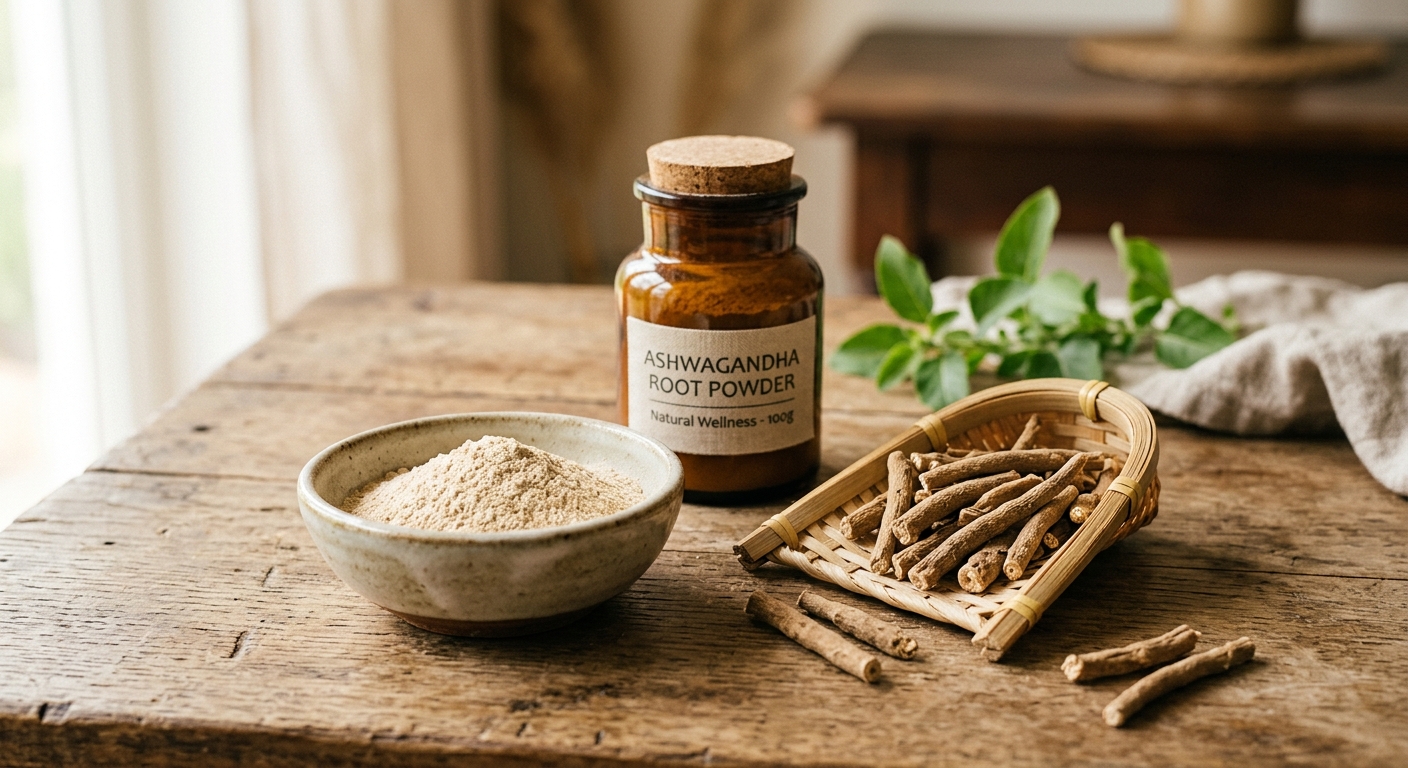
Ashwagandha has exploded in popularity — and for once, the hype has some science behind it. Searches for ashwagandha have grown year on year, driven by people looking for natural ways to manage stress, lower cortisol, and support hormone health. But not all ashwagandha supplements are equal, the doses vary wildly, and some of the claims go further than the evidence supports.
This guide covers what ashwagandha actually does, what the research shows, how much to take, and who it's best suited for.
What Is Ashwagandha?
Ashwagandha (Withania somnifera) is an adaptogenic herb that has been used in Ayurvedic medicine for over 3,000 years. The root is the part most commonly used in supplements. The name loosely translates to "smell of horse" in Sanskrit — referring both to its distinctive odour and the traditional belief that it conferred the strength and vitality of a horse.
As an adaptogen, ashwagandha helps the body resist physical and psychological stress. It does this primarily by modulating the hypothalamic-pituitary-adrenal (HPA) axis — the control system that governs your stress hormone response.
What Does Ashwagandha Actually Do?
The active compounds in ashwagandha are called withanolides — steroidal lactones concentrated in the root. These interact with stress pathways, immune signalling, and hormone receptors. Here's what the research consistently shows:
1. Reduces Cortisol
Cortisol is your primary stress hormone. In short bursts it's essential, but chronically elevated cortisol drives anxiety, poor sleep, belly fat accumulation, and suppressed testosterone.
Multiple randomised controlled trials (RCTs) show ashwagandha meaningfully reduces cortisol:
- A 60-day study published in the Indian Journal of Psychological Medicine found a 27.9% reduction in serum cortisol in the ashwagandha group versus placebo
- A double-blind trial in adults with chronic stress reported significant reductions in cortisol alongside improvements in stress scores, sleep quality, and quality of life
- Effect sizes are consistently larger in people with higher baseline stress levels
Bottom line: If your cortisol is chronically elevated due to stress, ashwagandha has strong evidence for bringing it down. If you're already low-stress, the effects will be more modest.
2. Supports Testosterone Levels
Cortisol and testosterone have an inverse relationship — when one rises, the other tends to fall. By lowering cortisol, ashwagandha creates conditions for better testosterone production. But there's also direct evidence:
- An 8-week study found men taking ashwagandha had significantly higher testosterone and luteinising hormone (LH) compared to placebo
- A study in men with infertility showed increases in testosterone alongside improvements in sperm quality
- In resistance-trained men, ashwagandha supplementation produced greater increases in testosterone, muscle mass, and strength compared to placebo over 8 weeks
The effects are more pronounced in men with suboptimal testosterone (due to stress, age, or poor sleep) than in those already in the healthy range.
3. Improves Strength and Body Composition
Beyond hormones, ashwagandha has direct effects on physical performance:
- Significant improvements in bench press and leg extension strength versus placebo in resistance-training studies
- Greater increases in muscle size (chest, arms) over 8 weeks of training
- Reduced exercise-induced muscle damage and faster recovery
4. Enhances Sleep Quality
Ashwagandha improves sleep — not by sedation, but by lowering the cortisol that keeps you wired at night. Studies show:
- Faster sleep onset (reduced sleep latency)
- Better sleep efficiency (less time lying awake)
- Improved subjective sleep quality scores
- The glycowithanolide triethylene glycol in ashwagandha root has been specifically shown to induce sleep in animal models
5. Reduces Anxiety and Stress
Across multiple studies using validated stress and anxiety scales (PSS, DASS-21, GAD-7), ashwagandha consistently outperforms placebo for reducing perceived stress and anxiety. Effects appear within 2-4 weeks and strengthen over 8-12 weeks of use.
6. Cognitive Benefits
An 8-week RCT in adults with mild cognitive impairment found ashwagandha improved:
- Immediate and general memory
- Executive function and processing speed
- Attention and information-processing speed
This may be partly due to reduced cortisol (which impairs memory) and partly from the neuroprotective properties of withanolides.
What Ashwagandha Doesn't Do
The marketing can overreach. Here's what the evidence doesn't clearly support:
- It won't double your testosterone. Effects are meaningful but modest — typically 10-20% increases in those with suboptimal levels
- It's not an immediate fix. Most benefits emerge over 4-12 weeks of consistent use
- It won't replace lifestyle. Sleep, stress management, and diet are more impactful than any supplement
- It's not for everyone. Thyroid conditions, autoimmune disorders, and pregnancy warrant caution (see below)
Which Form of Ashwagandha Is Best?
Most research uses standardised root extracts. The two most studied are:
- KSM-66: The most extensively studied extract, standardised to ≥5% withanolides from root only. Used in the majority of testosterone and cortisol studies. Generally considered the gold standard
- Sensoril: Uses root and leaf, standardised to ≥10% withanolides. More studies on sleep and cognitive function. Slightly lower doses used (125-250mg vs 300-600mg for KSM-66)
What to look for on the label: "KSM-66" or "Sensoril" with a standardised withanolide percentage. Generic ashwagandha powder with no standardisation has inconsistent potency and less research behind it.
Dosage: How Much Should You Take?
Effective doses from clinical research:
- KSM-66: 300-600mg daily, taken once or split into two doses
- Sensoril: 125-250mg daily
- Generic root powder: 1,000-5,000mg daily (less predictable potency)
Start low: 300mg/day is a sensible starting point. Some people get full effects at this dose; others respond better to 600mg. There's no benefit to exceeding 600mg of a standardised extract.
When to Take It
- For stress and cortisol: Morning or early afternoon, with food (reduces mild GI side effects)
- For sleep: Evening, 30-60 minutes before bed
- For hormones and performance: Timing matters less — consistency is more important. Many people take it with dinner
Ashwagandha is fat-soluble, so taking it with a meal that contains some fat improves absorption.
How Long Does It Take to Work?
- Stress and anxiety: 2-4 weeks
- Sleep: 1-2 weeks
- Cortisol reduction: 4-8 weeks
- Testosterone and body composition: 6-12 weeks
- Cognitive function: 8-12 weeks
Patience is key. Ashwagandha is not a stimulant — you're not meant to "feel" it immediately. The benefits build gradually as HPA axis regulation normalises.
Is Ashwagandha Safe?
For most people, yes. Ashwagandha is well-tolerated at recommended doses. That said:
- GI discomfort: The most common side effect — usually mild and resolved by taking with food
- Drowsiness: Can cause sedation in some people, especially at higher doses. Adjust timing accordingly
- Thyroid: Ashwagandha may increase thyroid hormone levels. People with hyperthyroidism or on thyroid medication should consult a doctor before using it
- Autoimmune conditions: As an immune modulator, caution is warranted in autoimmune diseases (lupus, rheumatoid arthritis, etc.)
- Pregnancy: Avoid — may stimulate uterine contractions
- Liver: Rare case reports of liver injury exist, mostly at very high doses or with poor-quality products. Stick to standardised extracts at recommended doses and don't exceed 3-6 months of continuous use without a break
Who Benefits Most from Ashwagandha?
Ashwagandha is not a universal supplement. You'll get the most out of it if you:
- Are under chronic stress or have elevated cortisol
- Have suboptimal testosterone (due to stress, poor sleep, or age)
- Struggle to wind down or have poor sleep quality
- Are training hard and want to reduce recovery time
- Want a non-stimulant approach to anxiety management
If you're already sleeping well, have low stress, and normal hormone levels, the effects will be more subtle.
How to Stack Ashwagandha
Ashwagandha pairs well with other evidence-based supplements:
- Ashwagandha + Magnesium glycinate: Synergistic for sleep and cortisol reduction. Both work on the HPA axis from different angles
- Ashwagandha + Zinc: Zinc directly supports testosterone synthesis while ashwagandha reduces cortisol — a solid hormone-support duo for men
- Ashwagandha + Vitamin D: Vitamin D deficiency reduces testosterone. Combining both addresses two common deficiencies simultaneously
- Ashwagandha + Omega-3: Omega-3s reduce inflammation, and ashwagandha reduces cortisol — complementary for overall stress and recovery
Track your stack in SuppaLog: When combining supplements, it's important to know exactly what you're taking, when, and how much. SuppaLog's AI label scanner extracts dosages automatically, and you can set reminders to keep your timing consistent across supplements.
Quick Reference Summary
- Best form: KSM-66 (300-600mg) or Sensoril (125-250mg)
- Daily dose: Start at 300mg, increase to 600mg if needed
- Timing: Morning for stress/energy, evening for sleep
- With food: Yes — improves absorption and tolerability
- Timeline for results: 4-12 weeks of consistent use
- Best for: Stress, cortisol, testosterone support, sleep, recovery
- Avoid if: Pregnant, hyperthyroid, or on immunosuppressants